Thursday, April 6, 2017

Deep Tine Aeration Complete

The large, solid tines on this aerator can go deep
On Tuesday we were able to complete aeration to our greens. This is the only aeration we will be performing until fall. This spring, in an attempt to penetrate our layer of buried organic material, we contracted out a deep tine aeration. While we didn't pull cores, this deep tine form of aeration is more vertically aggressive. The holes made by the machine go nine inches deep, which allows us to incorporate sand through our buried organic layer. What does this mean for golfers? Stronger root systems, which help provide healthy turf, and excellent playing conditions.
View of impact deep tine aeration can have on soil
The finished product on #9

Friday, March 24, 2017


#7 Construction Phase Complete
New drop inlet in fairway to which the re-graded area will run to
Sod over the trench that holds the new outlet pipe
Today the contractors were able to finish the construction phase of the drainage project on #7 fairway. Now that construction is complete we enter the establishment phase of the project. #7 will remain a par 3 until the sod has had time to take root. Once the sod has rooted, the hole will  be re-opened as a par 4. The hole will then remain cart path only until we feel that the area can tolerate cart traffic.             


Newly graded and sodded fairway from the front

Newly graded and sodded fairway from the rear

Progress Near #3 Cart Path
The area to the right of #3 cart has eroded due to cart traffic and tree roots, making the area aesthetically displeasing and unsafe for carts to traverse. With some of the sod we were able to re-use from the project on #7 we were able to make progress to this unsightly area. We hope to complete work to this area as soon as we can feasibly manage.
Before
After


Thursday, March 16, 2017

#7 Project Update
The contractors for the drainage project on #7 were able to make it to Greenbrier earlier than expected last week due to the unseasonably warm, dry weather we were having. Unfortunately when they got here they were greeted by more typical cold, wet weather. With that said, progress is going very well, and once the exposed ground dries out, the construction phase of the project should only be 1-2 days from completion. At that point we will enter the establishment phase. This phase will keep #7 as a par 3 until the sod has fully rooted. Once the turf has rooted we will re-open the hole as a par 4, with cart path only restrictions. Below are some pictures showing progress made so far on the project, and how these steps are already paying dividends.
The area was cut out and stripped. Some of the better areas of sod were removed and used on the course.
New drop inlet located in the fairway is intentionally set below the initial grade to allow for more fall to the drain.

This box blade attachment setup with laser grading capabilities automatically adjusts to move dirt to predetermined heights creating the proper gradient to move water to the new drop inlet.
Any exposed area would be wet after 1.5 inches of rainfall, but this picture shows that the newly installed drainage system is already working it's magic!  No more puddling or lakes on #7.


Thursday, March 9, 2017

Sod Laid on Holes 12,13, and 14

As we barrel quickly out of "winter" and into spring, we took the time to put the finishing touches on some of the work that we had started in 2016. The dormant sod we have laid will cover the trench line from the project on #13 and tie in some areas on mounds and around cart path edges. These areas will be circled with a white line and will be ground under repair until they are established.
Sod Prep


Sod to trench line

Cart path edge #13

Behind #13 green

#14 mound


Wednesday, December 21, 2016

New Irrigation Line Complete

Last week we were able to complete our supplemental irrigation line to improve irrigation coverage to the renovated area on hole 13. The area did not previously have solid irrigation coverage, because the left side of the hole was inhabited by primarily trees and bare ground. The newly renovated area is growing on very sandy soil and is still subject to cart traffic and root intrusion. With all of these drying factors at play, the installation of this new line will ensure that the work done to improve the hole is successful in the future. We replaced sod where it was possible to pull solid pieces, but in many areas along the path, the root intrusion made harvesting sod impossible. In these areas, the dirt on the trench line will be given time to settle, and sod will be purchased to cover these areas in the late winter / early spring months. As a reminder, the cart rule on holes 13 and 14 will remain Path Only during the winter months. 

 Below are some pictures of the process of adding our new irrigation line to 13.
Measurements, plans, marking the existing line and shutting down water begin the project

The existing irrigation is hand dug to confirm pipe size and prepare for tie ins


Tie ins to the irrigation line are set before trenching begins

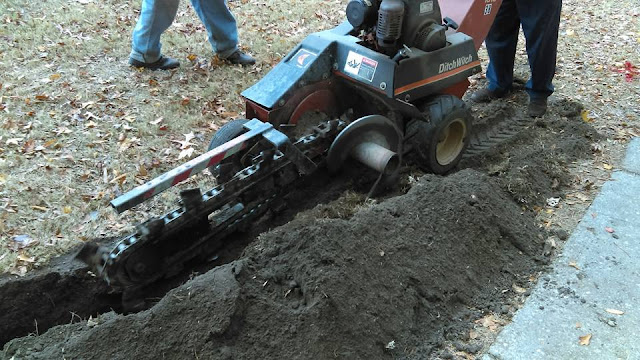
It's always nice when the trencher can easily blaze the trail

Nice and easy.......right?

But sometimes you need the back ho


And in cases like this, the stump grinder acts as the trencher
Pipe and swing joints are installed

Wires are set properly in trench and connected to satellite box

Irrigation heads are installed and wired up

The trench is then back filled and the edges are cleaned up
Water is turned back on and........Success!


Thursday, December 1, 2016

You've Got Questions, We've Got Answers

Why is the rough so thick?


With the weather this year we were able to achieve some of the healthiest Bermudagrass conditions we have seen here at GCC in quite a while. During the summer the rough was growing so vigorously that we made a slight adjustment to the height of cut (quarter inch) to be able to keep up with the rough. Given the recent history of winter kill, we have decided to leave the rough at this slightly higher height so that we can capitalize on the successful growing season and ensure that the Bermuda will transition well this coming spring.Damon and I have both played the course in the past week and feel that some of the challenges finding golf balls are related to leaf litter and the low angle of the sun at this time of year. In the spring we will be mowing the rough shorter than we have in the past to give ourselves room for adjustment in the event that we run into an extremely hot summer again next year. We do not believe that the rough will be this thick every year, but feel that we have an opportunity to take advantage of the growing season we had by leaving the height where it currently sits. As the cold has a greater impact on the rough throughout the winter, and we continue to circle the course with the mowers to mulch leaves, we suspect the rough will not seem as thick as it currently does. We will also continue to monitor the situation by playing the course ourselves to maintain the perspective of a golfer. We will continue to strive to balance healthy turf conditions with fair playing conditions.

What happened on Holes 3 and 4? 

On Sunday there were multiple fires set on Holes 3 and 4. The fire department and police responded and believe that the fires were intentionally set. The areas affected by the fires are all in the rough, and we do not anticipate any significant turf loss. To clean the ash we will run a mower over the area, and allow upcoming rains to knock the ash down. We intend to be patient in this process. A brush or more aggressive method might make the area appear cleaner, faster, but could also damage the dormant turf. Outside of being a bit aesthetically displeasing, the areas should not have a negative affect on play ability. If anyone has any information regarding the fires or previous vandalism to #4 green, please contact the Chesapeake Police Department.

Why is there so much digging and trenching going on on Hole 13?


We are very pleased with the results of our renovation to the left side of hole 13, but our work is not done. In order to ensure that all of the work we did this summer is successful in future, we are installing a supplemental irrigation line along the cart path to improve irrigation coverage to the renovated 

area. Once we have the line installed and the newly sodded area makes it through its first winter, we will be able to open the hole to cart traffic again. As you can see in the picture of the trench line to the right, this area is very sandy. Sandy soil in conjunction with cart traffic and tree root intrusion certainly warrant the installation of this line.
Thick tree roots along the cart path will require a back ho to dig the line and are evidence of one the contributing factors to years of poor turf health on #13

Why did we aerate the greens so late? Will they continue to grow in?


Unfortunately we had to push back our aeration date twice this year due to extreme weather events. Even though there was a risk that the greens would not fully recover in time for winter, we understand how crucial this process is to the long term health of our greens, and felt that the risk was justified. We have been fertilizing aggressively to capitalize on the last bit of growing season we have available. We believe that the greens are currently not perfect, but still very playable. While the rate of growth has slowed on our greens, we can still anticipate at least marginal improvement as long as conditions remain consistent with the annual norms here in Chesapeake.

Former Golf Course Superintendent Ben Pritchett was aerating greens 3 times a year, and this picture gives a great illustration of why. Many of our greens have a pre-existing issue with a buried layer of organic material. This dense mat of muck can restrict root growth. Many of the areas that thinned out during the extreme heat of this summer had a significantly more dense layer than pictured above. The continued incorporation of sand through this layer is essential to the health of our greens.
The greens are still a little bumpy in spots, but we feel they still provide an acceptable playing surface until they fully heal.


Thursday, November 3, 2016

Winter Preparations
As the weather pushes the course into dormancy and the off season, there are a number of practices and applications that we implement to improve playing conditions for the winter months, and make sure transition in the spring goes smooth. Here are some of the things we do to prepare for winter.
We raise the mowing heights on our high maintenance Bermudagrass areas. We do this to help bolster the health of the Bermuda as it heads into its most stressful season, and help improve play ability through the winter months. Dormant Bermuda can create some tight lies in fairways.
We perform many chemical and fertilizer applications. Potassium can help "toughen up" the Bermudagrass for the stressful winter that lays ahead. Pre-emergent herbicides can help suppress winter weeds, which can stand out like a sore thumb in dormant Bermuda. We also do some selective fungicide applications to help prevent disease which may not even manifest itself until spring. Many of these application need to be watered in, so if you see irrigation running on a cold day and wonder why, this is a likely explanation.

Another exciting part of winter preparation is assessing areas in need of improvement, and coming up with a comprehensive plan of what we hope to accomplish in the off-season.


All of the things we do now influence how the course will look for 2017!